

D-Day In A Manger
why Herod understood Christmas better than most of us

NOTE: This post is a bonus that will remain available to free subscribers permanently!
American Christmases have become reminiscent of many things, few of which are the reason Christmas actually exists. When your neighbor, who does not believe in Jesus, thinks about Christmas, they think about holiday travels, last-minute gifts, frantic food preparation, family fights over the dinner table, excessive spending over presents that will last barely a week, and a number of other general anxiety-causing events or reasons to hurry and bustle about with worried expressions.
But what should you, as a son or daughter of the King, think about Christmas? To answer this query, we need to ask the all-important question: what is Christmas?
Around two millennia ago, in what is now the West Bank of Palestine—six miles south of Jerusalem—there was a small town called Bethlehem. It’s a bustling place now, but it was a small and unimportant rural town back then. And on a quiet, still night, not long after the events which we now commemorate at Christmas took place, the peace of Bethlehem was shattered with heart-rending screams of grief. Groups of soldiers, going door-to-door, were entering houses and murdering every innocent child they found. Every male child who was less than two years old in Bethlehem was brutally executed by Judean soldiers that night.
Then was fulfilled what was spoken of by the prophet Jeremiah:
“A voice was heard in Ramah,
weeping and loud lamentation,
Rachel weeping for her children;
she refused to be comforted, because they are no more.”
Matthew 2:17-18 (ESV)
The blood of these precious children was spilled, not because they were guilty of any human crime, but because of one tyrannical king who feared a challenge to his throne. Herod the Great, King of Judea, had heard a report that the long-awaited Messiah—the savior of the Jews and the expected military deliverer of God’s people—was born in Bethlehem. Wise men from the East, journeying to worship the Messiah, unknowingly alerted him to this. Herod, in his jealousy and ignorance, decided to kill every baby boy in Bethlehem to ensure that his line would remain on the throne of Judea forever and to prevent this Messiah from usurping his power.
In doing so, Herod displayed a better understanding of Christmas than most Christians have. When he heard about the birth of the Messiah, he didn’t throw a party. He didn’t welcome the Messiah into Judea. He started brutally killing people. He did so because, ironically, he grasped the true meaning of Christmas. I can promise you that Herod wasn’t thinking about candy canes, trees, gifts, or magic. He recognized what Christmas was—the greatest threat to his throne that had ever occurred.
You see, in Christmas, the Messiah did come. He came in the form of a baby boy named Jesus, born to a poor carpenter and a teenage girl. And this Jesus was far more important than anyone could have ever fathomed…..for He was not only an appointed deliverer of Israel, but Yahweh in human flesh, come to save His people.
He came humbly, in a wooden stable, surrounded by filthy animals and laying in coarse straw. But this beginning, despite how humble it was, was the fulfillment of a declaration of war. The night may have been peaceful, but it wasn’t a ceasefire. It was D-Day. It was the day that the world turned upside-down, the angels sang for joy, and every last one of Satan’s demons turned white with fear.
In Genesis 3:15, God declared war on the serpent (Satan) and his seed. This declaration, known as the proto-evangelium, is the first in a long line of prophecies about the promised Messiah, now come in the person of Jesus.
I will put enmity between you and the woman,
and between your offspring and her offspring;
he shall bruise your head,
and you shall bruise his heel.
Genesis 3:15 (ESV)
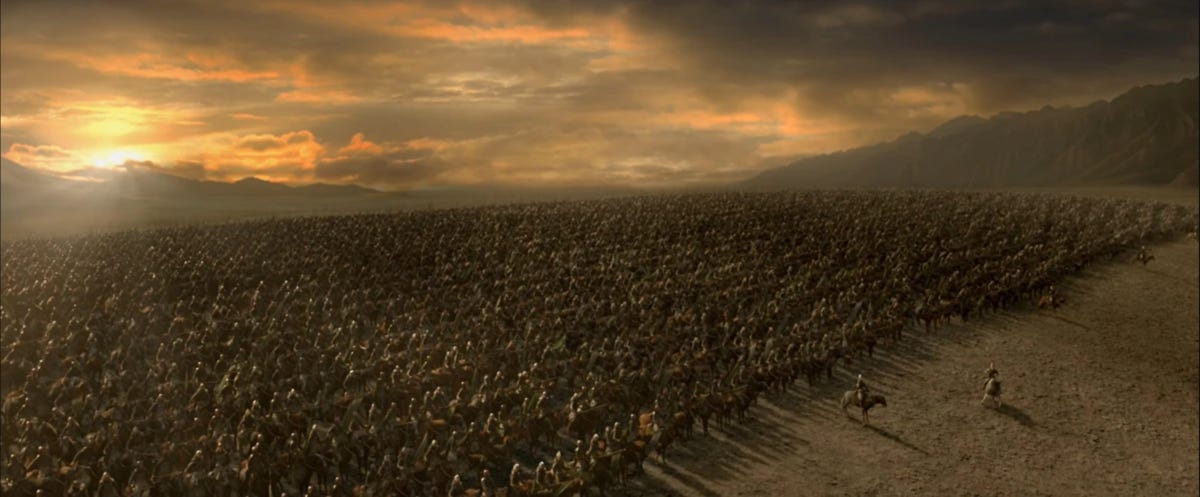
The prophecy of Genesis 3:15, despite the poetic language, cannot be made to align with Coexist bumper stickers. Nor is it aligned with a view of Christmas that is solely fresh snow, peppermint, and happy endings. Don’t get me wrong: Christmas is a time for joy and true happiness. But, as John Piper so aptly puts it, it is a time for serious joy, not lightheaded silliness. If we are Christians who truly appreciate God’s redemptive plan for the human race and the importance of Jesus’s birth to this redemptive plan, we rejoice, not because everything will be happy and good and fun now, but because the armies of the Rohirrim are in sight. It is a joy that is clear-headed, purposeful, and cheerfully violent—if it can be called violence—for all the right reasons. If you are one who professes faith in Jesus Christ, then I challenge you to practice joy in that way. Not as the world defines joy, but as a man of Gondor who sees that beautiful sight: thousands upon thousands of armed horsemen charging into the Pelennor. The battle is not yet won, and the fight has actually just begun in earnest. Many are as yet doomed to die—perhaps even yourself—but that does not matter. Nothing matters, except delivering Middle Earth from the tyrannical advance of Sauron.
The long foretold Seed of the woman, according to God, was going to crush the head of the great serpent, Satan. Christmas, the birth of Jesus in the stable, is when that Seed entered the world.
But when the fullness of time had come, God sent forth His Son, born of a woman, born under the law.
Galatians 4:4 (ESV)
This cannot be described as anything but a strategic invasion of an evil-ridden Earth at exactly the right moment. Satan had held all of Creation in bondage since our first father and mother sinned in Eden, and Christmas was the beginning of the final liberation campaign to rescue the human race. The small baby in the manger was a grenade the size of Russia thrown into Satan’s kingdom.
In Revelation 12:1-5, we see exactly what was happening behind the scenes while this small baby lay in the manger, crying for his mother.
And a great sign appeared in heaven: a woman clothed with the sun, with the moon under her feet, and on her head a crown of twelve stars. She was pregnant and was crying out in birth pains and the agony of giving birth. And another sign appeared in heaven: behold, a great red dragon, with seven heads and ten horns, and on his heads seven diadems. His tail swept down a third of the stars of heaven and cast them to the earth. And the dragon stood before the woman who was about to give birth, so that when she bore her child he might devour it. She gave birth to a male child, one who is to rule all the nations with a rod of iron, but her child was caught up to God and to his throne.
Revelation 12:1-5 (ESV)
This cosmic, spiritual drama was taking place the whole time. No one on Earth knew, and if they knew, they would be at once terrified and overjoyed. And in this moment, when the great dragon, Satan, failed to destroy the Child, the demonic realm shuddered. Perhaps only for an instant, and perhaps it was imperceptible, but it was the warning sign of an earthquake that would, in thirty short years, upend the world and shatter their authority over men.
This baby, wrapped in cloths and lying in a manger, was always going to be headed for another set of cloths and another tomb. The incarnation is absolutely about invasion, but it’s also about substitution and atonement. God became man in the first place so that man’s sin could be placed on God’s shoulders and carried to a Roman cross. Christmas is inseparable from Good Friday.
So yes, Jesus came to wage war against Satan and death. But His weapon of choice wasn’t a sword or any physical army. It was His own broken body. The decisive battle of the human race wasn’t fought with legions of angels descending from heaven, it was fought by one man, naked and alone, dying the horrific death we deserved. Isaiah 53 tells us He was “pierced for our transgressions, crushed for our iniquities.” The baby born in Bethlehem was born to bleed and triumph in the same breath.
This is where the warfare imagery and the love of God for broken sinners converge. Jesus came both to defeat the enemy and rescue the hostages. Christmas is the invasion, yes. But it’s an invasion motivated by love so fierce and so costly that it demanded the invader’s own life as the price of victory. John 3:16 doesn’t say “God so hated Satan that He sent His Son to destroy him.” It says “God so loved the world that He gave His only Son.” Both are true. The war against evil and the rescue of sinners are the same mission, impossible to separate.
Throughout Jesus’s ministry, the Bible records encounters our Lord has with demons. Every time it happens, they recognize him outright and beg Him not to torment them “before the time”. They knew what Christmas meant. They knew that judgement day, for them, had come early. And they were terrified. Likewise, Herod’s paranoia wasn’t just a shrewd political calculation of a wicked king or jealousy for his throne. It was a deep-seated and well-founded fear, with spiritual reality behind it. In the birth of Jesus, God didn’t sneak into the world. He literally kicked down the door.
Now, since the Fall, this carnal world has been occupied territory. “The whole world lies in the power of the evil one,” as 1 John 5:19 tells us. Every square inch of creation that rightfully belongs to God has been under hostile control, and Jesus came to reclaim what was His by right of Creation and conquest.
In Matthew 12:29, Jesus asks his listeners a rhetorical question: "How can someone enter a strong man's house and plunder his goods, unless he first binds the strong man?" The answer is obvious—you can't. The threat must be neutralized first. Christmas, purely and simply, is the binding of the strong man. Every miracle Jesus performed, every demon He cast out, every sick person He healed, and every sermon He preached was an act of war against, and a systematic dismantling of, the kingdom of this world.
The manger was the beachhead. Calvary was the decisive battle where the enemy's power was broken forever. The resurrection was the declaration of total victory. And the King will return to finalize it all at the end of the world. But you wouldn’t know any of this from looking at modern Christianity or how most American evangelicals celebrate the holiday we’re celebrating today.
Thus, Christmas is simply a celebration of the invasion of the Son of God into a broken world to cast out the darkness and bring forth light to a people lost in sin. Emphasis on invasion.
But what does this change about our American holiday?
Christmastime, originally the commemoration of an invasion of enemy territory, has become a feel-good holiday about family togetherness, movies, and hot cocoa. The church in our day wants Jesus the life coach, not Jesus the conquering King. This is because we’ve been seduced by the Enemy into thinking we're living in peacetime, when we're actually huddling together in the trenches of Normandy. We've forgotten that we're an invasion force, not a religious club.
This is why we’re so ineffective in everything we do. This is why we have failed to prevent America turning from Christ. This is why the culture walks all over us. This is why we're losing ground on every front. We've forgotten what Christmas (among many things) actually was—and what it means for us now. We’ve domesticated the King into a Nativity mascot of pacifism, and we wonder why the culture doesn't take us seriously.
The angels announced "peace on earth" when Jesus was born. But read the rest of it: "among those with whom He is pleased." There is no peace among those with whom God is not pleased, only the terrifying reality of an eternity in Hell. And for those with whom He is pleased, they enjoy a peace through a hard-fought victory. God made peace by the blood of the cross, as Colossians 1:20 tells us. It's a peace that cost something because it was won on a battlefield.
Christmas was the invasion. The war is won, but it's not yet finished. We're living between D-Day and V-Day. Victory is certain, and it has been guaranteed by the empty tomb and the promises of God. But the fighting continues. The enemy knows he's beaten, but he is hell-bent on taking as many down with him as he can (pun not intended).
So don’t celebrate Christmas like it's a birthday party for a nice teacher who said some inspiring things. Don’t sing carols like you're at a campfire sing-along. Christmas trees, family dinners, movies, gifts, lights, candy….none of that is bad. All of the traditions of American Christmases are good things that God gave us to enjoy—and enjoy them we should. The real change needs to occur in our hearts and our attitudes. Christmas is the commemoration of the day God invaded enemy territory and began the campaign—originally prophesied in Genesis—that would end with Satan's head crushed under His heel.
The baby born in Bethlehem came to destroy the works of the devil and bring salvation to mankind. He wasn’t safe, and He wasn’t sentimental, but He was good. His purpose on Earth was to wage war: not a physical war of armies and swords and political intrigue, but a spiritual war against Satan and death, far more deadly and far more serious than any other war he could have waged.
Herod understood that, and he sought to kill Him. The demons understood that, and they groveled before Him. The dragon in Revelation 12 understood it, and he knows his reign is over.
Do you?
Merry Christmas, friends. Enjoy your day. But let it be a day of serious joy, a warrior’s Christmas, and a day of worshipping our great God.
Contra mundum,
Carson
Who said he was safe? Of course he isn’t safe! But he’s good. —Mr. Beaver
Such an epic post Carson. Spot on. Every time you write I can always count on two things:
1) you’ll deliver hard truths
2) you’ll deliver them in style
Excellent post, Carson! It's so sad to see how we've let the true meaning of Christmas disappear. Keep up the good writing :)