

A Touch of Grace
Ben Sasse and dying a death worthy of your life

There is a picture of former Congressman Ben Sasse, taken sometime this past winter, in which his face is bleeding. The skin around his eyes and nose and along his jaw is broken open in harsh red welts and seeping rivulets, the way a child's knee bleeds after a hard fall. He has metastatic pancreatic cancer that has spread to his liver and his lungs, and the drug keeping him alive—an experimental therapy called daraxonrasib, the only thing standing between him and the four-month death sentence he was handed last December—is also, in his words, so nasty that his body cannot grow skin fast enough to keep itself whole. It is slowly killing him, and also slowly saving his life.
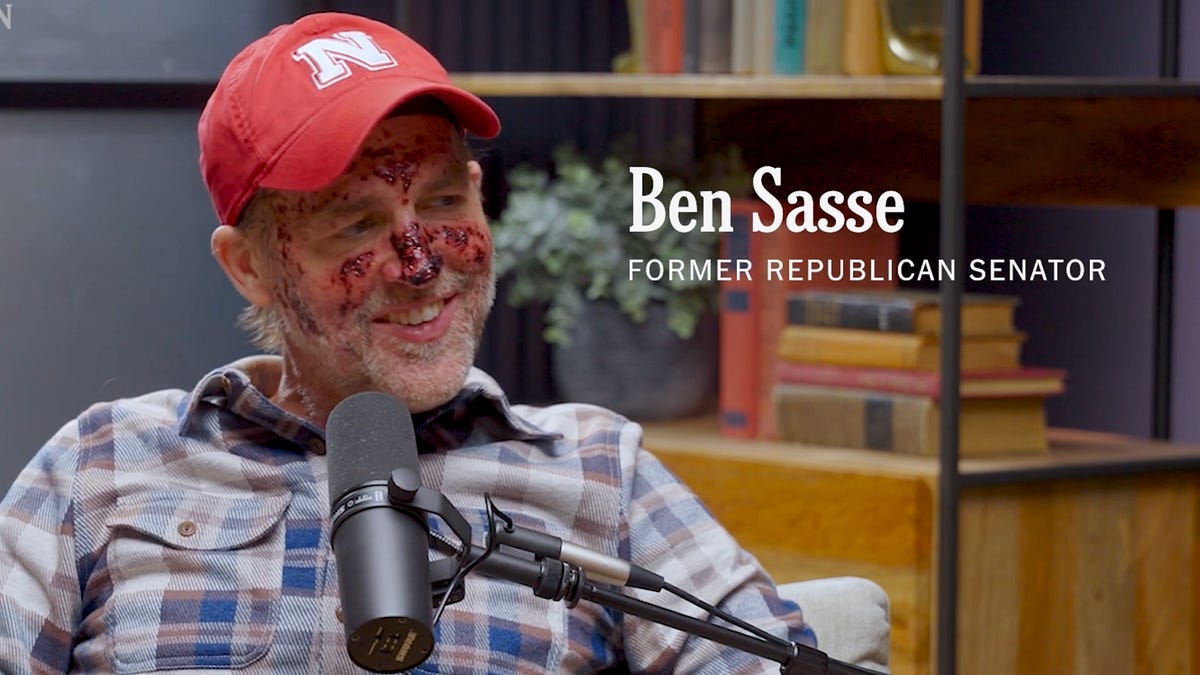
Sasse is fifty-four. He has a wife of thirty-one years. He has a fourteen-year-old son and two college-age daughters. He was told just a few months ago that he had less then four months to live. Now, against every actuarial expectation, doctors are calling a seventy-six percent reduction in tumor volume and giving him a chance—not a promise, a chance—at more time.
He calls the whole thing “a touch of grace.”
We live, you and I, in a world that has two settings for suffering. The first is denial. We medicate it out of existence, we distract from it and pretend it isn’t there, we shove our aging parents behind closed doors at hospice facilities and assisted living centers, we treat wrinkles and back pain as a failure of self-care and dying as a kind of social embarrassment. The second setting, when denial finally collapses, is despair. The heart-rending wail of rage at Heaven. The sense that something deep has gone catastrophically wrong with the universe and someone—God, the doctors, the government, the universe itself—owes us an apology and restitution.
Both settings are, in their own unique ways, refusals. Refusals to look at the thing set in front of us.
What Ben Sasse is doing in public right now is something else entirely. He is looking at it squarely in the eye. He told 60 Minutes that being told you are dying in your early fifties is strange because everyone suddenly treats you like you are ninety-three, like you have wisdom you have not earned. He said he was bummed—that was his word, “bummed”—that he would not be there when his son turns sixteen, eighteen, twenty. He has stated repeatedly and clearly that he wishes nothing more than to spend what remaining time he has left glorifying God in his life and conduct.
He said that he and his wife were going to be apart for a time.
A time. Not forever. A time.
The Christian tradition, of which Ben Sasse is a prominent member, has a long and very contrarian way of looking at death. We don’t pretend death isn’t real, but neither do we accept its power over us. We don’t pretend it doesn’t hurt, but neither do we pretend that the hurt lasts forever. The shortest verse in the Bible is “Jesus wept” (John 11:35), and He wept at the tomb of a friend He was about to raise from the dead. He knew the ending, and He cried anyway. The grief was not a failure of faith or judgment, but rather the appropriate human response to a thing that was never supposed to be.
And then He called Lazarus out.
That is, simply, the whole shape of it. Weep at the tomb. Then call the dead man out. Hold both precious at once—the heart-rending grief and the stubborn hope of resurrection—and refuse to surrender either one to the other. Despite what the world may tell you, those two things are not self-contradictory. And this is exactly what Ben Sasse is modeling in public, and the reason it is worth paying attention to is that almost no one in our culture knows how to do it anymore. He is not projecting a glib macho confidence that pretends it isn’t suffering. He went on the interviews and displayed the welts and the blood and all, for anyone to see. He is not pretending he isn't grieving the future that has been taken from him, the son's sixteenth and eighteenth and twentieth birthdays that he has been told he will most likely not be alive to attend. He used the rather insignificant word “bummed” on national television, which is the small, flat, unheroic word a father reaches for when there are no words left, and yet he still meant it, and he did not apologize for it. And in the same interview and the same breath and the same life he said that what he wanted was to spend whatever remained of his days glorifying God, and that he and his wife were going to be apart for a time.
A time. Not forever, but a time.
This is the only reason I’m writing any of this, and the only reason you ought to be reading it. You see, you are also dying. You will not be given the strange and terrible mercy that Ben Sasse has been given, which is a doctor in a lab coat naming a number of months and forcing the question all the way to the front of your life where it can no longer be ignored. You are being given, instead, something far more dangerous: the slow forgetting, the daily and comfortable assumption that there is always going to be more time than there actually is, and the silent ongoing refusal to ask the question that Ben can no longer avoid asking. The question is is not whether you are happy or fulfilled or self-actualized or living your best life, but whether you are living for Christ, and whether, if you were handed tonight what Ben Sasse was handed in December, you would be able to say without flinching that the answer was yes.
For most of us, if we are honest, the answer is no. Or not yet. Or not really. Or I keep meaning to. We have constructed entire lives around the assumption that the serious business of faith is something we will get to when the kids are older, when the career has stabilized, when we have a little more bandwidth, when the next thing is finally settled and the noise of our particular season dies down enough that we can hear ourselves think. We treat the Lordship of Christ as a long-term project that can safely be deferred to a more convenient and well-lit season of life, the way we defer dental cleanings and difficult conversations and the cleaning out of the garage. And we do all of this in direct defiance of the only thing we actually know for certain about our own lives, which is that we have no idea how long they are. I’ve said this before, and I will say it again. You might die in fifty years on a hospital bed surrounded by your family. Or you might die tonight in your sleep, or you might die tomorrow on your way to work when that semi driver falls asleep at the wheel and runs the red light, or you might die before you finish this post merely because God wished it to be so. He has not guaranteed you a single second of life, and your heart is only continuing to beat because of his grace. If you continue to ignore this terrifying fact, then the odds grow exponentially larger every moment that you will pass from this world to the next and be caught unawares. Or, that the City of God will invade the City of Man for the last time, and you will also be caught unawares.
Therefore, stay awake, for you do not know on what day your Lord is coming. But know this, that if the master of the house had known in what part of the night the thief was coming, he would have stayed awake and would not have let his house be broken into. Therefore you also must be ready, for the Son of Man is coming at an hour you do not expect.
Matthew 24:42-44
The drug eating through the skin of Ben Sasse's face has stripped that ignorance away from him. The question has been pushed all the way to the front of his life and there is no more behind to push it back to. And what he is doing with what remains—publicly, while bleeding, with children at home and a wife of thirty-one years sitting beside him—is the thing every one of us was baptized into and called toward and almost none of us are actually doing. He is living, in real and specific and visible ways, for Christ. He is treating the Resurrection as though it were true. He is calling the whole bleeding catastrophe a touch of grace, because if Christ is who Christ said He is, then it actually is one.
The grace that you have been given is that you have not yet been handed your December. The danger you are in is that you have not yet been handed your December. Both of those are the same sentence, and which of the two ends up describing your life depends entirely on what you do with the time you do not know the length of. Ben Sasse is going to spend his remaining months, however many of them God sees fit to grant him, glorifying the Christ he believes is waiting for him. The only question worth asking yourself right now, and it is the question this whole essay has been circling from the very first paragraph, is whether you are going to spend yours doing the same thing, or whether you are going to keep waiting for a more convenient and better-lit season of life that you have been promised, by exactly no one, will ever actually arrive.
There is still time. But there is not, as Ben Sasse can tell you and as the rest of us go to truly extraordinary lengths not to hear, forever.
A time. Only a time. Spend it for Christ, or spend eternity wishing you had.
Part blog, part manifesto, the Compass charts a teenage writer's pursuit of truth, goodness & beauty at the intersection of theology, politics, & satire.
Thank you for this reminder.
Around this time in 2022, I had a close family member who was diagnosed with stage four colon cancer. She was in her mid thirties, a wife, mom, and had the sweetest servant's heart for Christ. She passed away about a year after her diagnoses. Watching her example of faith and peace as she faced death that (by the world's standards) was coming too soon truly changed my life. We should all live like we are dying, because in actuality, we are.
Just about to watch his 60 Minutes interview for school. Very good post.
God bless you and your family!